ILJIN Electric
-
Business Area

By Business Division
- Company
-
Investor Relations

Investor Relations
- Media Center
-
Sustainability

Sustainability
- Careers
- Customer Support


Life Cycle Assessment (LCA)
Life Cycle Assessment (LCA)ILJIN Electric conducts Life Cycle Assessments (LCA) on its major products, including extra-high-voltage cables, transformers, and aluminium rods, to systematically analyze environmental impacts throughout the entire product life cycle, from raw material procurement and manufacturing to use and end-of-life disposal.
Based on the LCA results, the Company continuously pursues environmental impact reduction and the development of environmentally friendly products. In addition, ILJIN Electric has obtained an Environmental Product Declaration (EPD) for its aluminium rod products and transparently discloses product environmental information.
Pollution Management
Pollution ManagementILJIN Electric systematically manages air pollutants, water pollutants, and waste generated throughout its business operations to minimize environmental impacts.
Based on its ISO 14001 Environmental Management System (EMS), the Company continuously monitors pollutant emissions and strictly complies with environmental laws, regulations, and emission standards. In addition, regular environmental inspections and environmental impact assessments are conducted to proactively identify and prevent potential environmental risks.
-
Waste Management
ILJIN Electric manages the entire waste management process, from generation and storage to treatment, across all business sites in accordance with established procedures. Through thorough waste segregation, we maximize recycling rates while minimizing landfill and incineration. In addition, residual materials from production are recycled as raw materials to reduce environmental impacts.
-
Water and Wastewater Management
Water used in production processes is managed with a focus on conservation and efficiency, while wastewater is classified and treated according to pollutant sources to prevent water pollution. ILJIN Electric also monitors annual water consumption and wastewater discharge to drive continuous improvement.
-
Air Pollutant Management
Air pollutant emissions, including particulate matter, SOx, and NOx, are regularly monitored and managed at each business site. We minimize emissions by operating air pollution control facilities and strictly complying with environmental regulations. In particular, the Hongseong Plant has installed low-NOx burners in its boilers to reduce nitrogen oxide (NOx) emissions, contributing to the protection of air quality.
Green Technology Certification
Green Technology CertificationThrough continuous efforts in developing environmentally friendly technologies and reducing environmental impacts, ILJIN Electric has obtained the Green Technology Certification awarded by the Ministry of Environment. This certification recognizes the technological excellence and environmental benefits of the Company's technologies.
-
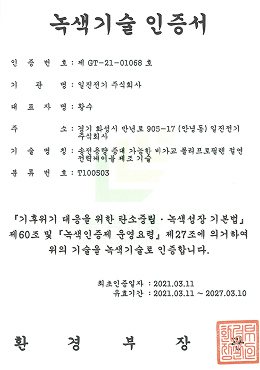
Green Technology Certificate
Download
Environmental Education
Environmental Education1. Specialized Training for Environmental Managers
ILJIN Electric regularly provides specialized training related to environmental management practices, including waste management, air and water quality management, and integrated environmental management, to strengthen the capabilities of environmental managers. In addition, ISO 14001 Environmental Management System (EMS) training is conducted to continuously enhance competencies in environmental risk prevention and regulatory compliance.
2. Environmental Education for Employees
ILJIN Electric provides environmental education programs for employees to enhance their understanding of environmental management. Through training on climate change response, resource conservation, and environmental protection, the Company promotes environmental awareness and encourages environmentally responsible practices.