ILJIN Electric
-
Business Area

By Business Division
- Company
-
Investor Relations

Investor Relations
- Media Center
-
Sustainability

Sustainability
- Careers
- Customer Support


Sustainability
Risk Management System
Risk Management SystemILJIN Electric ensures transparent and accountable governance by clearly defining the roles and responsibilities of the Board of Directors and executive management, while strengthening internal controls to guarantee fairness and transparency in decision-making. Based on this framework, we comply with legal and ethical standards, protect the rights and interests of stakeholders, and build mutual trust. The company also identifies and assesses legal, financial, and non-financial risks — including those related to quality, environment, and occupational health and safety — and takes proactive measures to mitigate potential impacts. By continuously improving our risk management system through stakeholder feedback, ILJIN Electric maintains a systematic and documented risk management framework that supports sustainable operations. Through this process, we strive to turn risks into opportunities and establish a solid foundation for long-term sustainable growth.
Risk Management Process
Risk Management ProcessILJIN Electric operates a risk management process to identify, assess, and respond to both financial and non-financial risks and opportunities, including those related to management, quality, environment, and occupational health and safety. We define risks by reflecting internal and external issues as well as stakeholder expectations, analyze their potential impacts, and implement appropriate response and monitoring measures. All related information is documented and recorded, enabling ILJIN Electric to establish a continuous and systematic risk management framework embedded throughout the organization.
-
Risk Definition
- Defining as risks any potential factors that may hinder the achievement of corporate objectives
- Identifying risks that may cause both financial losses and non-financial impacts
- Considering key issues and the requirements of major stakeholders
- Analyzing comprehensively the sources of risks, possible events, and potential consequences
- Assessing the existing risk-management framework and evaluating current management practices
-
Risk Evaluation & Analysis
- Comprehensively evaluating the likelihood and potential impact of the identified risks.
- Conducting objective quantitative and qualitative assessments with the involvement of relevant stakeholders.
- Quantifying the likelihood of risks based on the analysis of historical data.
- Assessing the degree of impact that risks may have on related management systems and processes.
- Classifying risk levels by taking both likelihood and impact into comprehensive consideration.
-
Risk Response & Monitoring
- Identifying and implementing measures to mitigate risks.
- Setting key performance indicators (KPIs) to achieve risk management objectives.
- Applying various risk management strategies, including mitigation, avoidance, and transfer.
- Continuously monitoring and evaluating risk management activities.
- Revising and refining risk response strategies based on monitoring results.
-
Risk Communication & Reporting
- Supporting tailored reporting systems based on risk-assessment outcomes.
- Establishing an effective decision-making framework led by top management and strengthening execution.
- Building a foundation for continuous improvement through systematic documentation of risk-management activities.
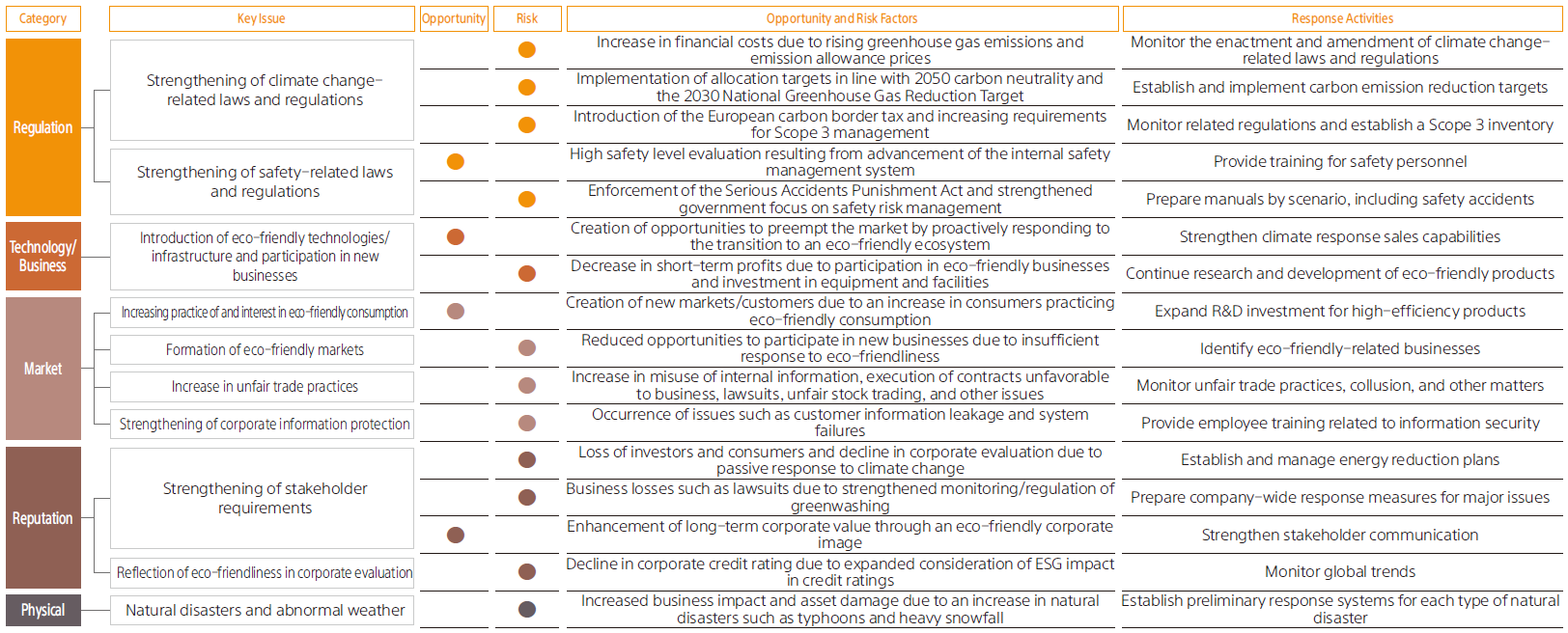
Risk and Opportunity Analysis
Risk and Opportunity Analysis